
The aerospace and defense sectors are evolving at breakneck speed. As a Chief Marketing Officer or executive at a scaling aerospace company in Colorado, you are tasked with professionalizing your marketing department while navigating the aggressive "Second Space Race." You know your engineering is world-class. You have actual flight heritage. You possess tangible, heavy metal hardware sitting on your shop floor.
Yet, you are likely facing a massive external threat. You are losing lucrative Department of Defense contracts and tier-one investor funding to flashy, Silicon Valley backed space startups. These new disruptors often lack your manufacturing capabilities, but they possess a massive visual advantage. Their marketing looks like a Hollywood sci-fi film, while your branding feels like a relic of a dusty bureaucracy.
This creates a dangerous phenomenon known as the Perception Gap. You have Technology Readiness Level 8 hardware, but your marketing looks like a Level 2 prototype. Buying committees and venture capitalists are human. They are easily swayed by cinematic, aggressive visual intelligence. If a competitor's CGI rendering looks more operational than your actual physical hardware, you will lose the bid.
At Born Tomorrow, we serve as your industrial video specialist. We guide scaling defense contractors out of the legacy trap by deploying modern, technically accurate visual intelligence. To dominate the 2026 aerospace landscape and defeat the vaporware startups, you must adapt to shifting consumption habits. Here is a forward-looking roadmap of the top five video marketing trends every aerospace defense contractor must watch and implement.
1. The Pivot Toward Documentary Style Authenticity
The era of sterile, overly scripted corporate videos is dead. In 2026, defense procurement officers, investors, and elite engineering recruits can spot inauthentic marketing instantly. They are exhausted by generic stock footage of people shaking hands in brightly lit boardrooms.
To build ultimate trust and destroy the vaporware narrative, aerospace brands must pivot toward documentary style authenticity. This means turning the camera on your actual shop floor and highlighting the gritty reality of advanced manufacturing. It involves capturing the unscripted intensity of a master machinist solving a complex problem, or interviewing a lead engineer while they stand in front of a 5-axis CNC mill.
By prioritizing the physical reality of your facility over a sanitized corporate facade, you prove operational readiness. You stop claiming you are an innovator and start visually documenting the undeniable proof of your expertise.
2. AI Assisted Rendering for Classified Rapid Prototyping
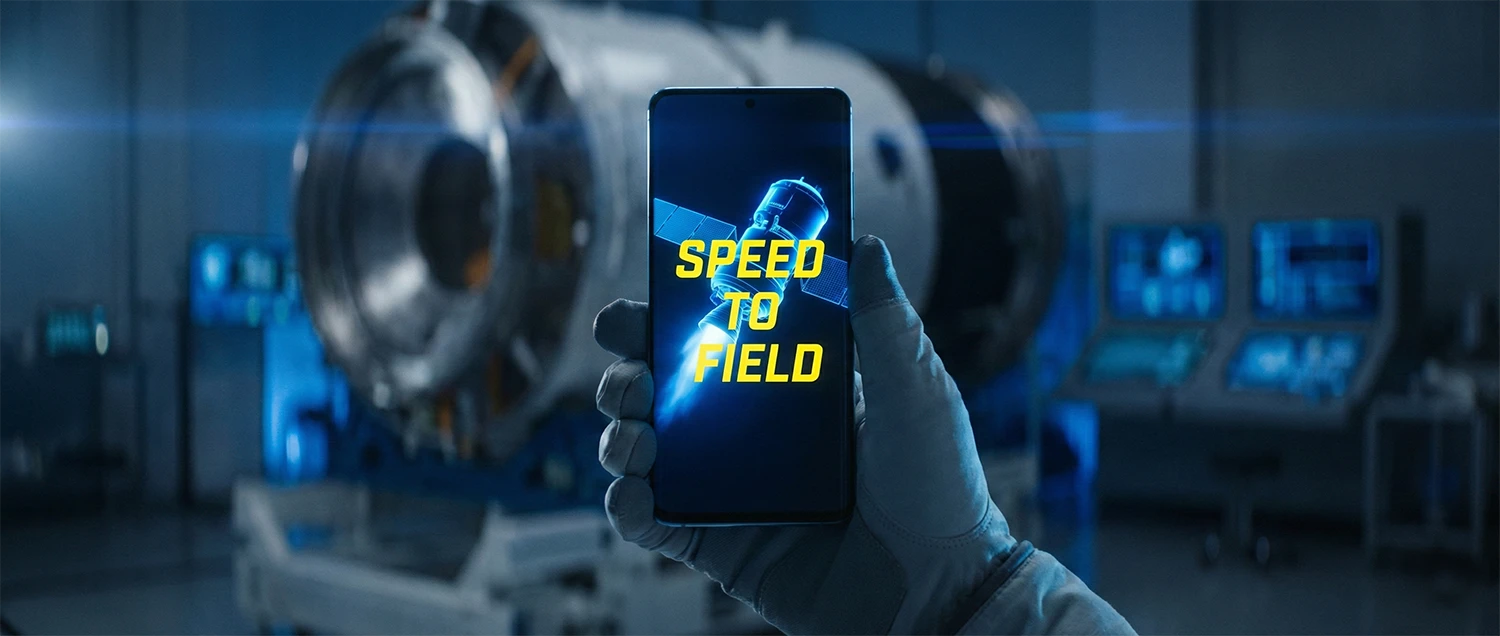
In the defense sector, speed to field is the ultimate mandate. However, marketing a product that does not yet physically exist, or is too highly classified to film, creates a massive communication deficit. In 2026, the solution is the aggressive adoption of AI assisted 3D rendering.
Generalist agencies rely on slow, traditional animation pipelines that take months to execute. At Born Tomorrow, we utilize advanced rendering workflows to rapidly generate photorealistic digital twins of your CAD files. If you are pitching a proprietary satellite bus or a hypersonic glide vehicle component, we can build a cinematic, high-contrast digital environment around your technology in a fraction of the time. This allows your sales team to visually communicate complex internal mechanics and secure Phase III contracts before the first physical prototype is even milled.
3. Short Form Vertical Integration for Talent Acquisition
The Colorado aerospace corridor is starved for elite technical talent. If your recruitment strategy relies on text-heavy job postings on traditional career boards, you are invisible to the next generation of engineers.
The consumption habits of top-tier talent have fundamentally shifted toward mobile-first, short form content. To win the war for engineering talent in 2026, defense contractors must deploy short form vertical video integration directly into platforms like LinkedIn and targeted social feeds.
These are not silly consumer videos. They are highly tactical, fifteen second "Day in the Life" bursts of visual intelligence. We capture the sparks flying off a lathe, the precise movements within a clean room, and the intense focus of your team. By consistently feeding these vertical assets into the algorithmic feeds of your ideal candidates, you transform your company from a boring factory into an aspirational tier-one technology hub.
4. Silent Storytelling for Trade Show Dominance
Trade shows and industry expos require massive capital investments, yet most defense contractors waste their booth presence by playing audio-dependent videos in a deafeningly loud exhibition hall.
The trend for 2026 is absolute silent optimization. You must assume your audience will never hear a single word of your video. To intercept the gaze of a passing procurement officer within a critical three second window, your video must rely on aggressive kinetic typography and high-contrast visuals.
By animating your most critical claims like "ITAR Compliant" or "Flight Heritage Proven" in massive, tactical colors like Hazard Yellow or International Orange, you force the attendee to stop and engage. Your video loop becomes an active gravity well that pulls buyers into a technical conversation, completely independent of audio.
5. Transparent OPSEC and ITAR Compliance as a Marketing Tool
In the past, security protocols were hidden behind closed doors. In 2026, transparency regarding your operational security is a massive competitive advantage. Buying committees are terrified of intellectual property leaks.
Instead of simply stating you are ITAR compliant, the trend is to visually demonstrate your security posture. This involves producing content that highlights your strict clean room protocols, your cleared US-citizen workforce, and your encrypted data workflows.
When you proactively market your military-grade discipline, you aggressively reinforce the trustworthiness of your brand. You prove to the Department of Defense that you do not just understand compliance. You treat it as a religion.
Securing Your Position in the Second Space Race
Closing the Perception Gap does not require a hundred million dollar marketing budget. It requires strategic industrial fluency and a willingness to abandon outdated corporate tropes.
By embracing documentary authenticity, rapid AI rendering, and optimized distribution, your mid-market aerospace firm can project the undeniable authority of a global innovator. You can expose the hollow marketing of vaporware competitors, attract the best engineers, and win the contracts your physical technology deserves.
Stop letting legacy branding hold your world-class engineering back. Contact Born Tomorrow today to modernize your visual strategy and implement the video marketing trends that will define the aerospace sector in 2026.
About the author: