
Every manufacturing marketing team is currently asking the same question: "Can we use AI to make video cheaper and faster?"
The answer is yes, but with a massive warning label.
There is a dangerous misconception that AI can replace the camera. We see competitors pitching "AI Avatars" and synthetic voiceovers as a way to avoid the cost of filming. In the industrial sector, this is a strategic error. When you are selling high-trust engineering, authenticity is your currency. If you spend that currency on fake video, you bankrupt your brand credibility.
We believe in a hybrid approach. We use AI aggressively, but we keep it invisible. Here is the diagnostic checkup to determine when AI accelerates your production and when it destroys your trust.
Part I: The AI Scalability Advantage (The Good News)
We are not Luddites. We use AI every day. But we use it to accelerate the process, not to fake the product. In our agile production workflow, we leverage "Invisible AI" to reduce post-production time by up to 40%. This allows us to deliver content faster without compromising authenticity.
1. Speed to Market (The Editing Revolution)
The biggest bottleneck in video production isn't filming; it's the edit. Traditionally, finding the right soundbite from hours of interview footage took days.
Now, we utilize AI-Powered Transcription and Logging. Tools like Otter.ai allow us to transcribe technical interviews instantly. We can search for the word "throughput" or "tolerance" and instantly find the exact timecode where your engineer explained that concept. This reduces the "rough cut" phase significantly, allowing us to turn around project updates in as little as 24 hours. Read about how we created an entirely AI generated promo video for Pro/Tech.
2. The "Global Factory" (AI Dubbing)
Many of our manufacturing clients export globally, but producing separate videos for German, Chinese, and Spanish markets was historically cost-prohibitive.
New AI Dubbing tools allow us to clone your actual engineer's voice and translate their technical explanation into another language, retaining their tone and cadence. This allows you to repurpose one on-site shoot into a global sales asset for a fraction of the traditional cost, expanding your reach without expanding your travel budget.
3. Audio Clarity in Loud Environments
Factories are loud. In the past, filming an interview next to a CNC router required expensive sound blankets and hours of setup to combat the 85+ decibel noise floor.
Now, we use AI-powered tools like Adobe Podcast to isolate human voice frequencies and suppress industrial background noise. This allows us to film authentic interviews right on the factory floor—preserving the visual context—while delivering studio-quality audio clarity.
Part II: The Trust Crisis (The Bad News)
While AI accelerates the backend, using it on the frontend—where the customer sees it—is a liability. In B2B manufacturing, the stakes are high. Your buyer is not purchasing a commodity; they are integrating a multi-million dollar piece of equipment into their critical path. They need absolute certainty.
1. The "Uncanny Valley" of Industrial Trust
Trust is hard to build and easy to break. Recent data indicates that 82% of B2B buyers find AI-generated content less trustworthy than human-created content.
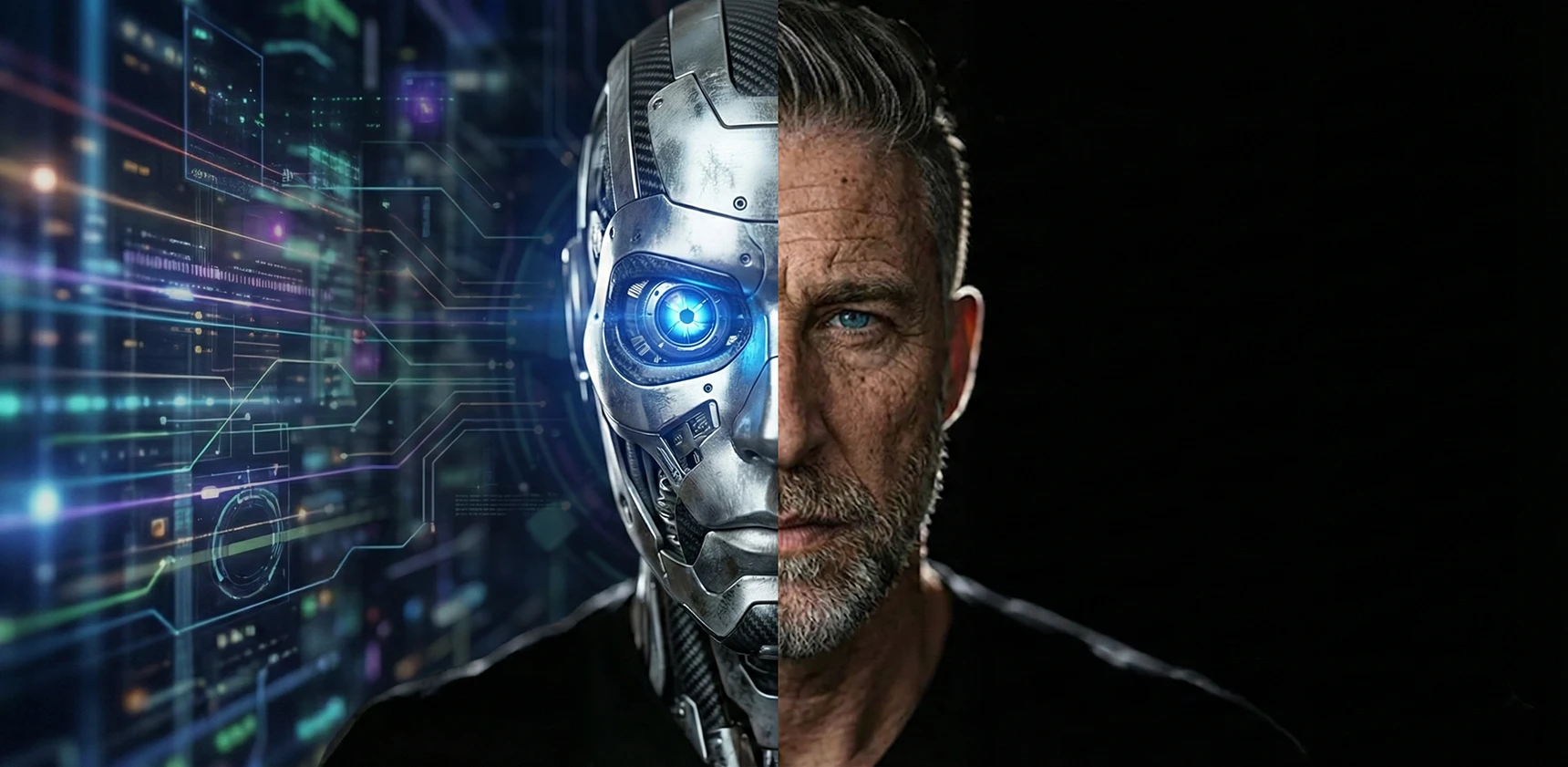
Using synthetic media introduces a psychological barrier known as The Uncanny Valley in the Factory—a feeling of unease when something looks human but isn't quite right. When a prospect sees an AI avatar delivering your value proposition, they don't see innovation. They see a company that wasn't willing to put a real engineer on camera. This widens the "Trust Gap" precisely when you need to close it.
2. The Hallucination Risk
Generative AI tools are notorious for "hallucinations"—confidently creating false information. In a visual context, this is disastrous.
AI video generators often fail to understand the physics of machinery. They might render a hydraulic hose connecting to an electrical panel or a gear spinning in the wrong direction. If a technical buyer spots a physics error in your b-roll, your authority is gone instantly. Relying on algorithms to generate training or safety visuals can easily lead to The Safety Compliance Catastrophe where incorrect procedures are visualized, creating massive liability.
3. The "Scam Signal"
Decision-makers are currently flooded with low-quality, AI-generated spam. If your brand video looks and sounds like a deepfake, you are subconsciously categorizing yourself with low-tier spam rather than premium engineering.
If your marketing materials feel fake, the buyer subconsciously assumes your engineering claims might be exaggerated too.
Part III: The "Human Moat" Strategy
As your competitors rush to use cheap, AI-generated content, you have a massive opportunity to stand out by doubling down on reality. This concept is called "The Human Moat".
1. Uncopiable Intellectual Property
In an era of infinite AI content, human reality becomes a scarce resource. Your specific facility, your proprietary prototypes, and your veteran staff are uncopiable intellectual property.
AI cannot prompt these things into existence. If you replace your people with avatars, you run into The Authentic Talent Acquisition Problem. Top engineers want to see who they will work with; they will not be recruited by a digital puppet. By filming your actual people and processes, you build a defensive moat around your brand that no competitor using ChatGPT or Midjourney can cross.
2. The Verifiable Audit
Video is evidence. When we film a continuous, unedited shot of your assembly line moving from station to station, we are providing a Verifiable Audit of your capacity.
AI cannot provide proof of work. Only a camera on your floor can document that you have the inventory, the staff, and the machines you claim to have.
Conclusion: The Hybrid Model
The future of industrial video is not about choosing between AI and Humans. It is about the Hybrid Model.
We use AI to edit faster, clean audio, and organize data so that we can spend more time on the factory floor capturing the one thing AI can never generate: the truth.
About the author: