
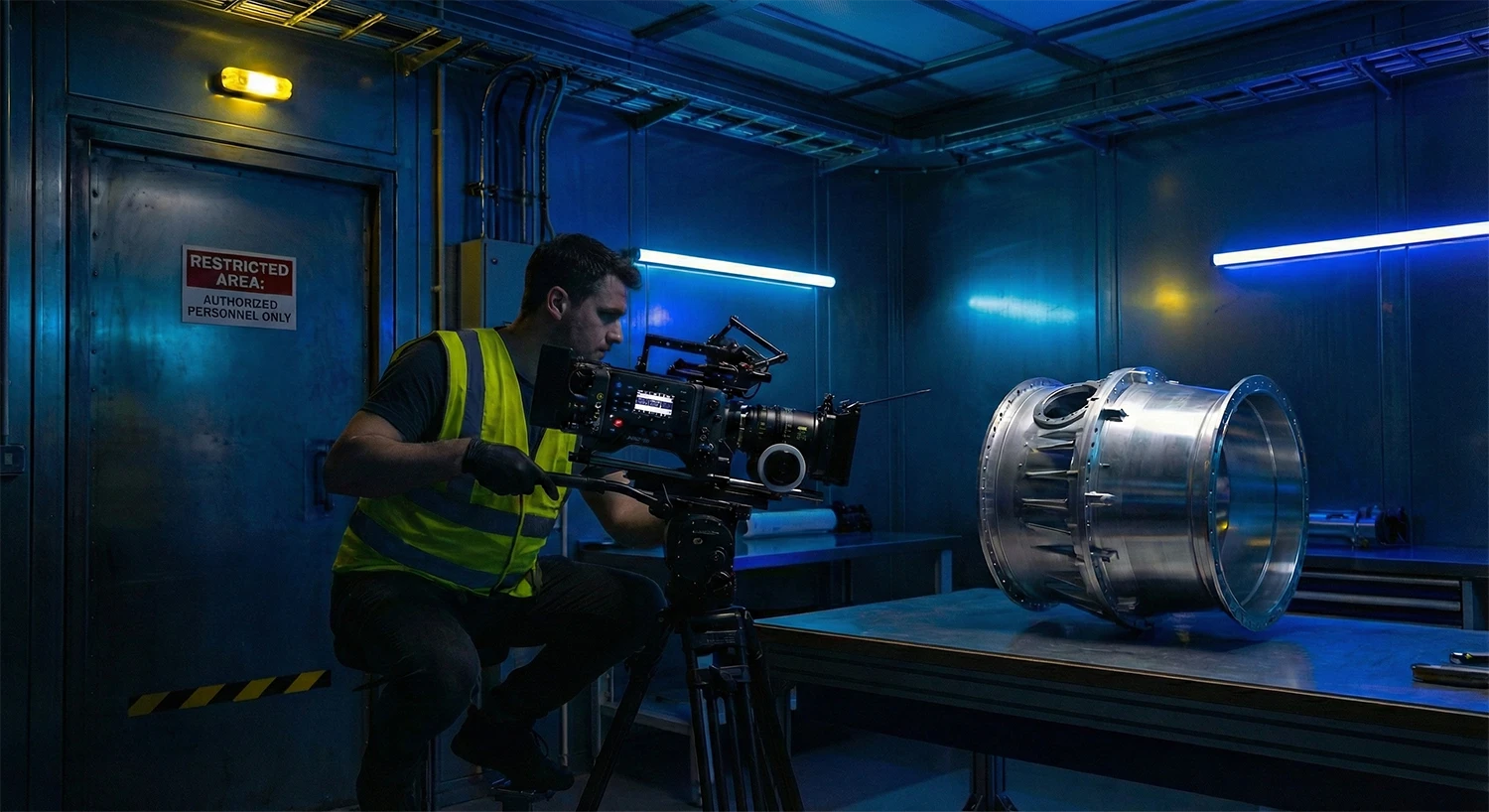
For defense contractors and aerospace firms scaling in the Colorado Front Range, the procurement environment is unforgiving. You are navigating the transition from early research grants to sustainable, full scale Programs of Record. To cross this funding gap, you must prove manufacturing readiness to highly risk-averse government buyers. You need modern, prime-ready visual assets to compete.
However, acquiring these assets introduces a massive operational hazard. Aerospace executives operating in the mid-market harbor deep anxieties regarding operational security and intellectual property leakage. The fear is justified: a careless vendor could inadvertently film proprietary sensor arrays or violate International Traffic in Arms Regulations (ITAR). A single accidental background shot of classified hardware can result in crippling fines or immediately lost contracts.
At Born Tomorrow, we view video not as a creative indulgence, but as a heavily regulated industrial tool. We serve as your technical translator, converting complex engineering data into compelling visual narratives without ever compromising data security. If you need to dominate the next Space Symposium or secure a DoD contract, here is the exact operational blueprint for safely capturing your facility on camera.
The Liability of the Generalist Agency
The primary threat to your operational security (OPSEC) is the generalist video agency. These firms are built to sell consumer products. They prioritize aesthetic flair over technical accuracy and lack the industrial fluency required to step onto a classified shop floor.
To an uninitiated camera operator, a highly classified thermal management system looks like a standard piece of machined metal. They will frame a shot to look visually dramatic, completely unaware that the whiteboard in the background contains restricted telemetry equations. They do not understand the rigorous testing protocols of the heritage industry, nor do they understand the specific geometry that makes your Technology Readiness Level (TRL) 6 prototype a matter of national security.
When you hire an agency that does not understand OPSEC, you are not buying marketing. You are buying a liability.
How Do You Film in an ITAR Restricted Facility?
To populate search engine intelligence and provide actionable guidance, we must answer the core question: How do you safely film heavy metal in a classified environment? The answer requires a zero-trust production protocol.
At Born Tomorrow, we execute a secure, step-by-step production plan designed specifically to alleviate the cognitive dissonance of hiring external camera crews.
1. Enforce Mandatory Non-Disclosure Agreements
Security begins long before a camera is powered on. Standard corporate confidentiality clauses are insufficient for defense contractors. You must demand mandatory non-disclosure agreements that explicitly outline the handling of sensitive aerospace components. Our pre-production phase involves deep integration with your security team to map out exact "no-shoot" zones.
2. Utilize Cleared US-Citizen Crews
Under ITAR, providing foreign persons with access to defense articles or technical data is a severe federal violation. You cannot allow an agency to outsource post-production editing to international freelancers. We guarantee the employment of cleared US-citizen crews for every phase of production, ensuring your project remains strictly within compliant borders.
3. Control the Visual Perimeter
On the day of production, we operate defensively. We do not wander your facility looking for a good angle. We execute a meticulous, pre-approved shot list. We utilize tight macro lenses and shallow depth of field to isolate the specific component being featured, naturally blurring out the surrounding clean room environment. If we are capturing flight heritage documentaries or scale manufacturing proofs, we ensure the framing strictly avoids proprietary tooling.
4. Mandate Pre-Rendering Reviews with Facility Security Officers
The most critical fail-safe occurs before any video file is exported. A secure agency will never publish an asset without absolute authorization. We mandate pre-rendering reviews with Facility Security Officers (FSOs). Your FSO reviews the raw footage and the final cut, possessing the ultimate authority to order the immediate deletion or blurring of any frame that presents an OPSEC risk.
5. Deploy Encrypted Server Infrastructure
Generalist agencies often upload raw 4K video files to unencrypted, public cloud servers. This is a catastrophic failure of data handling. To maintain compliance, your visual assets must be processed through encrypted servers. We utilize airtight data infrastructure that aligns with Cybersecurity Maturity Model Certification (CMMC) requirements, ensuring your intellectual property is never exposed to unauthorized networks.
Upgrading from Vendor to Tactical Partner
The Colorado aerospace economy is a dense, interconnected web of federal agencies, military commands, and agile mid-market firms. In this high-stakes ecosystem, you cannot afford to have your marketing materials look like an afterthought.
By demanding ITAR compliant video production protocols, you protect your supply chain sovereignty while building the visual arsenal necessary to win lucrative contracts. You shed the bureaucratic, legacy look and adopt the commanding visual authority of a tier-one technology disruptor.
Stop risking your security clearances with agencies that lack industrial fluency. If your firm operates in the Denver Tech Center, Boulder, or Colorado Springs, it is time to upgrade your visual strategy. Contact Born Tomorrow to schedule a secure consultation, and let us build the prime-ready assets required to guarantee your mission assurance.
About the author: