
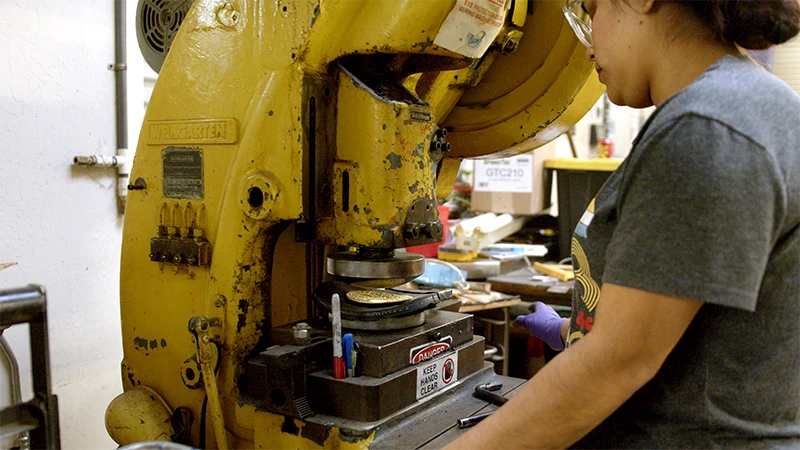
When seeking industrial video production in the Denver Metro area, you will encounter production companies that operate out of dedicated downtown sound stages and creative offices. They sell you on control and polish.
But for manufacturing and industrial clients, that overhead isn't a feature; it's a liability. It becomes the "Studio Tax," which is a mandatory surcharge for their fixed costs - staff, rent, utilities, and debt service - that is passed directly to your final invoice.
At Born Tomorrow, our model is built on efficiency: we operate without that fixed infrastructure. This lean, mobile, studio-less approach allows us to deliver high-authority, on-site industrial videography that is both more authentic and demonstrably cheaper than the studio-centric competition.
1. The Overhead Tax:
Paying for Empty Rooms and Idle Staff
A company maintaining a professional sound stage in Denver carries massive fixed overhead. These costs must be covered every month, regardless of whether your project is active:
Premium Commercial Rent: A dedicated studio space is a massive monthly burden. You are paying for their physical building, not for the service delivered to your production floor.
The Idle Staff Burden: Studio companies often maintain full-time, salaried roles (Studio Manager, Production Coordinator, dedicated Gear Custodian) that are required to run the facility. When that staff is not working on your shoot, you are paying their salary and benefits through your project quote.
Our studio-less model allows us to eliminate this Overhead Tax. We scale our team (cinematographers, audio engineers, editors) strictly to the needs of your project, ensuring you pay only for the talent and time directly applied to your factory floor.
2. The Cost Illusion:
On-Site is Always Cheaper Than "Faking It"
The primary cost failure of the studio model is the logistical inefficiency it imposes on the client. Filming a factory process means showing specific tools, products, and workspaces.
Cost Factor | Day Rate Fails | Project Rate Wins |
|---|---|---|
Material Handling | Client must spend valuable employee time and effort packing, transporting, and setting up specialty test jigs, proprietary tooling, or finished products at the studio location. | Cost is zero—the equipment is already in its authentic, operational state on the factory floor. |
Authenticity Gap | Even a perfectly staged product display or assembly bench will lack the wear, safety markings, and surrounding infrastructure of a real working environment. The viewer | Saves money—your authentic environment provides instant, verifiable credibility critical for B2B audiences. |
Reassembly/Calibration | Sensitive test equipment often requires | Saves time—we film the equipment exactly where it is used and calibrated, minimizing disruption and ensuring technical accuracy. |
The decision to rent a controlled stage forces the client to pay for the hassle of moving their production assets off-site. Our on-site approach ensures you save money and maintain 100% genuine technical context.
3. Efficiency and Authenticity:
Why On-Site is Faster
Beyond the financial savings, the studio-less, on-site model delivers superior speed and credibility:
Authenticity is Free: Your factory floor, especially in high-activity areas like the logistics centers near I-70, provides instant, verifiable credibility that a sound stage cannot replicate. This authenticity is critical for technical and B2B audiences.
Flexibility and Speed: We are not tied to a single, booked studio calendar. We can quickly adjust our schedule to fit sudden changes in your production run or your team's availability, ensuring the project is executed faster. If a specific interview needs a controlled environment, it is always cheaper to rent a small, local meeting room or a basic local sound stage for a few hours than to perpetually pay for a large, empty downtown facility. Check out how we created a full year's worth of video content in 2 days of shooting.
4. The Value Proposition:
You Pay for Expertise, Not Real Estate
When you hire a production partner, you should be investing in their ability to translate complex industrial processes into clear, high-authority video.
A company with a massive Denver sound stage is asking you to pay for their real estate. Our model allows you to invest every dollar directly into the on-site expertise—the specialized lighting, the high-quality audio equipment, and the industrial filming experience—that actually guarantees a successful video outcome.
The Studio Tax is an unnecessary overhead that industrial clients should refuse to pay.
Key Takeaways
The Studio Tax is the hidden cost of a competitor's fixed overhead. By choosing a studioless, on-site specialist, you gain authentic video documentation and directly avoid paying for expensive real estate and idle staff, ensuring the maximum possible ROI for your industrial video budget.
About the author: