
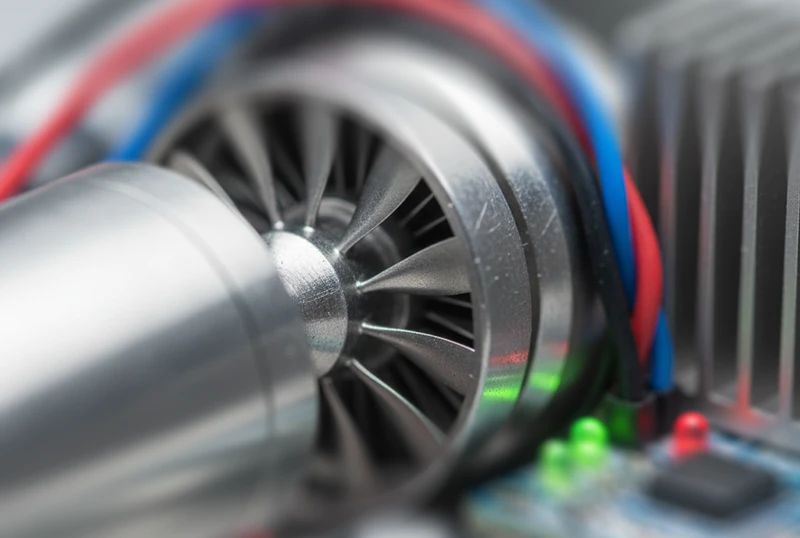
For manufacturers in the aerospace and defense sector, winning a federal contract isn't about submitting the lowest bid. It’s about meeting excruciatingly strict requirements for process fidelity, quality control, and security. A technical proposal can outline your capabilities, but it cannot effectively prove them.
This was the challenge facing a mid-sized precision parts manufacturer based near the Colorado School of Mines in Golden (we are still under an NDA). They were competing for a multi-year, multi-million-dollar federal contract that hinged on their ability to demonstrate a proprietary, seven-stage assembly line with near-zero error tolerance.
A text-heavy, static proposal was not enough. They needed aerospace video production that eliminated doubt and established verifiable trust. Here is the process we used to deliver a video asset that became the centerpiece of their winning submission.
1. Identify the Deal-Breaking Protocol
(ITAR Compliance)
In aerospace, video is not a marketing piece; it is technical documentation. We knew immediately that the primary audience—the government procurement review board—cared about two things: process and security.
The first step was identifying the one protocol that would cause an automatic failure if compromised: International Traffic and Arms Regulations (ITAR) compliance.
Actionable Scripting: We didn't film the finished product. We filmed the barriers. The script was built around showing security access controls, the process for logging component serial numbers, and the clean room environment.
Proof, Not Promotion: The camera focused on specific verification steps: a technician scanning a component's barcode, a signature in a physical logbook, and the restricted access signage common to facilities in the Denver Metro area that handle sensitive contracts.
This approach transformed the video from a 'sell' into an 'assurance' that addressed their core vulnerability.
2. Engineering Trust:
Advanced Technical Cinematography
The Golden area is known for its engineering and high-tolerance manufacturing. To appeal specifically to a review board looking for proof of quality, the video had to visually convey the concept of precision using specific equipment and techniques.
This section details the methods we deployed to film the production floor's exact standards:
On-Set Acquisition (The Golden Standard)
Macro Optics: We utilized a specialized macro lens system (e.g., a $100mm$ macro prime lens) to capture extreme close-ups of digital micrometers, calipers, and surface finishes. This visual proof of tolerances down to three decimal places is far more compelling than a photograph.
Motion Control Sliders: To demonstrate the smooth operation of a $3$-axis CNC machine or a delicate robotic arm, we filmed on a motorized slider. This ensures the camera movement is perfectly smooth and repeatable, mirroring the precision of the machinery itself and providing a sense of engineered control.
The High Frame Rate (HFR) Check: For capturing high-speed inspection processes, like a component passing a laser array, we filmed at $120$ frames per second (fps). This allowed the editor to slow the footage down five times in post-production, enabling the review board to verify every step of the high-speed check visually.
In-Studio Polish (Post-Production Techniques)
Luma Keying for Clean Text: Every verifiable data point—component ID, pressure reading, or tolerance value—was reinforced. We used Luma Keying in post-production to isolate the bright LED display of machinery readouts and added a clean, contrasting graphic overlay. This ensured that critical technical specifications were legible, even when the underlying footage was slightly dark or vibrating.
Temporal Noise Reduction: Manufacturing facilities are electrically noisy environments. To eliminate the digital grain or 'speckle' caused by low light or camera sensor noise, we applied Temporal Noise Reduction (TNR) during the color-correction phase. This is a subtle but vital technique that cleans the image, signaling a high standard of production quality suitable for a formal proposal.
Stabilization: Even with tripods, factory floors carry vibration. Every shot featuring static documentation (logbooks, instruction manuals) was run through a digital stabilization algorithm to eliminate minor camera shake. This ensures a rock-solid, authoritative image quality that implies control and seriousness.
The video achieved the rare task of being both technically accurate and visually compelling, appealing directly to the engineering mindset.
3. The "Virtual Walk-Through" for Remote Audit
A federal contract submission is often reviewed by dozens of decision-makers scattered across the country. They cannot physically walk the production floor, but the video had to give them the confidence of a physical audit.
We scripted the video as a virtual, guided facility tour for the reviewers.
This is very similar to the factory tour videos we do for our clients all the time.
Flow and Clarity: The scenes transitioned seamlessly, guiding the viewer from raw material storage to the final packaging bay, with on-screen text overlays identifying the department and key personnel responsible for the sign-off at each stage.
Verifiable Proof: The goal wasn't just to show the machine working, but to show the operator's interaction with the machine: the safety check, the calibration logs, and the specific personal protective equipment (PPE) required for that station. This documentation of compliance procedures is what wins trust with government entities.
4. Results:
Transforming Compliance into Competitive Advantage
The video was included as a required attachment in their technical volume. The manufacturer reported that during the Q&A phase of the bid review, the video drastically reduced the number of process-related questions they received.
The video successfully established:
Verifiable Process Fidelity: Proof that the manufacturer could execute the specific, complex process without shortcuts.
Regulatory Confidence: Assurance that their facility met or exceeded key security and quality standards, instantly mitigating risk for the procurement team.
Ultimately, the video served as the final piece of evidence, allowing them to confidently state their case and secure the multi-year contract. In high-stakes manufacturing, video is the most efficient method for transforming complex, proprietary processes into winning documentation.
About the author: