
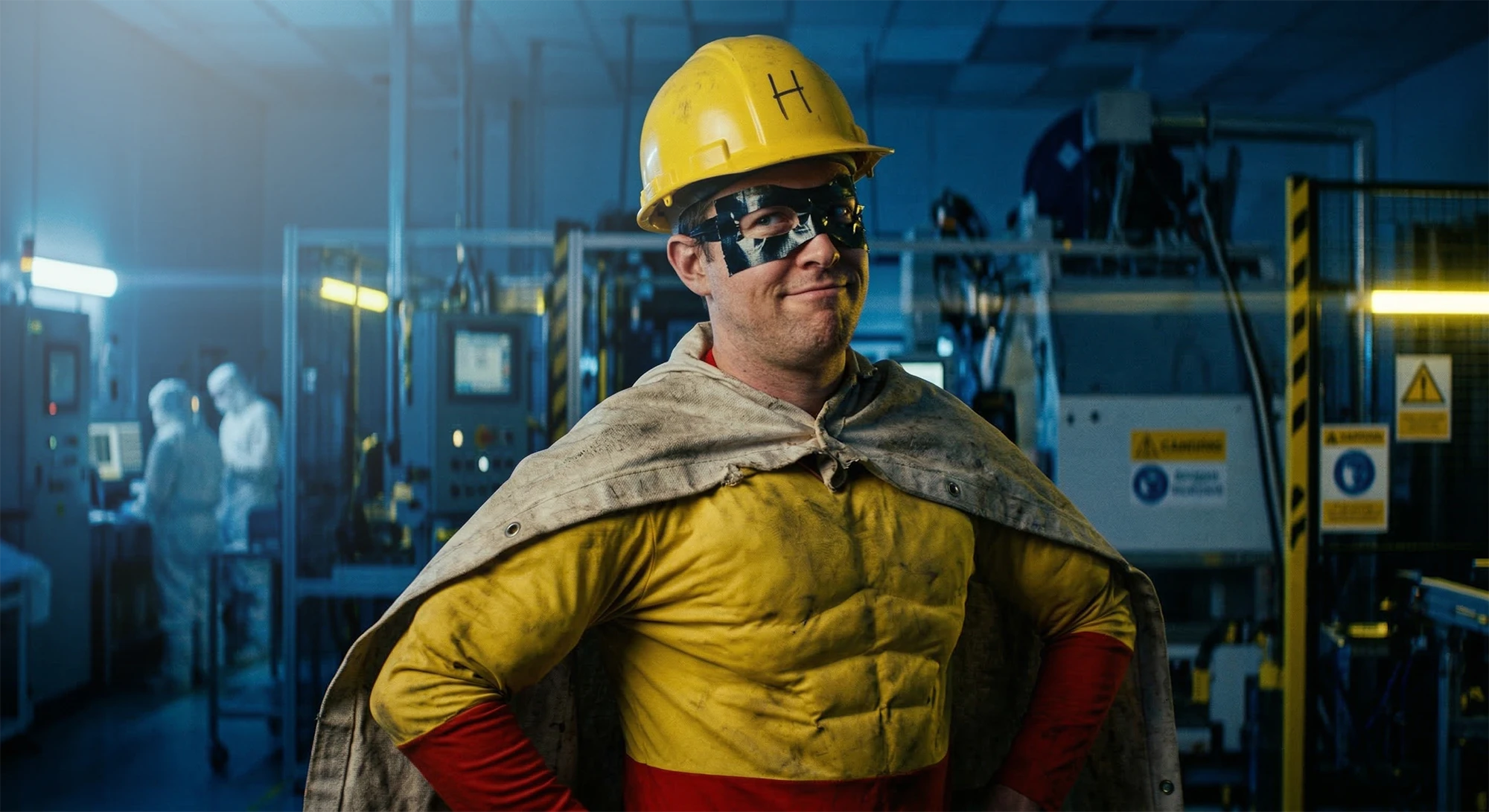
If you look at the digital footprint of the average advanced manufacturing or aerospace firm, you will notice a glaring, repetitive pattern. The homepage opens with a sweeping drone shot of a building. The primary headline reads something like, "Industry Leaders in Precision Machining Since 1985." The "About Us" page features a dense timeline of the company's founding, its equipment acquisitions, and a multi-paragraph manifesto about the founder's commitment to quality.
To the executive team that approved this messaging, it feels authoritative. It feels like a strong declaration of market dominance.
To the procurement officer or Chief Engineer evaluating the website, it feels like white noise.
Why? Because the marketing is suffering from a terminal case of corporate narcissism. The business has fallen into the ultimate B2B marketing trap: they have positioned themselves as the Hero of the story.
At Born Tomorrow, we operate under a fundamental psychological principle that dictates every strategy we build, every script we write, and every frame we film: The customer is the Hero. You, the business, are the Guide. This concept is constantly overlooked by mid-market industrial firms, yet it is the single most critical differentiator between a marketing campaign that accelerates the sales cycle and a campaign that burns capital. In this comprehensive breakdown, we are going to explore why playing the hero destroys your B2B pipeline, how the world's most successful brands deploy the "Guide" framework, and how our consulting-first approach transforms your aerospace or manufacturing brand from an ego-driven vendor into an indispensable industrial partner.
The Psychology of the Narrative Framework
Human beings process information through narrative. We are hardwired to understand the world through stories. Every compelling story, from ancient mythology to modern cinema, follows a nearly identical framework: A character (the Hero) has a problem, and they meet a Guide who gives them a plan and calls them to action, which ends in success and helps them avoid failure.
Luke Skywalker is the Hero; Yoda is the Guide. Frodo is the Hero; Gandalf is the Guide.
When a brand positions itself as the Hero—talking endlessly about its own history, its own awards, and its own greatness—it forces the customer into a competing narrative. The customer is already the protagonist of their own life and their own professional career. A Chief Engineer at a tier-one prime contractor does not wake up in the morning looking for another Hero to save the day. They wake up looking for a Guide who can help them solve their massive supply chain problems so that they can be the Hero to their own Chief Executive Officer.
When two Heroes walk into a room, they compete. When a Hero meets a Guide, the Hero listens.
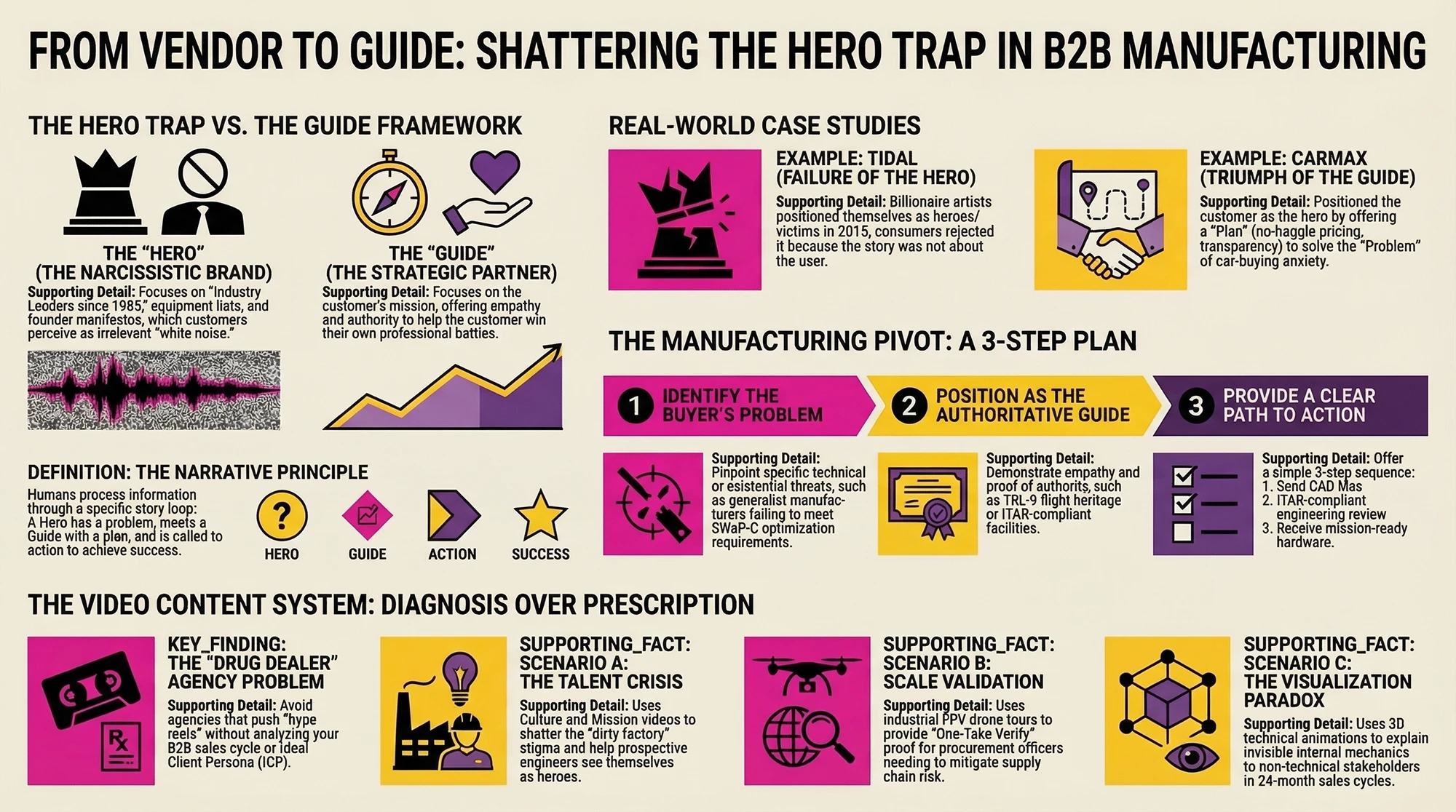
Real-World Case Studies: The Triumphs of the Guide and the Failures of the Hero
To understand how this dynamic plays out in the real world, we must look at companies that have either mastered this psychological framing or failed spectacularly because of it.
The Failure of the Corporate Hero: The Launch of Tidal (2015)
In 2015, a coalition of the world's wealthiest and most successful musicians, led by Jay-Z, launched a new music streaming service called Tidal. They held a massive press conference where a lineup of multi-millionaire artists stood on a stage and complained about how the music industry was treating them unfairly. They positioned themselves as the ultimate victims and the ultimate Heroes who were banding together to "change the course of music history."
The market backlash was immediate and brutal. Consumers actively rejected the platform. Why? Because the artists made the story entirely about themselves. They asked the average, working-class consumer to pay a premium subscription fee so that billionaires could get a fairer royalty cut. The customer was not the Hero of that story; the customer was just a wallet. Tidal's launch is a masterclass in the ego trap, proving that even the most famous brands in the world will fail if they forget who the protagonist is.
The Success of the Corporate Guide: CarMax
Contrast Tidal's failure with a brand that completely disrupted a notoriously frustrating industry: CarMax. Before CarMax, buying a used car was an adversarial battle. Traditional dealerships positioned themselves as the hero holding all the power, forcing the customer to haggle, stress, and worry about being ripped off.
CarMax disrupted the entire automotive market not by bragging about having the biggest parking lots or the smartest salespeople. Instead, they positioned the consumer as the Hero who deserved an empowering, transparent experience. The customer's problem was anxiety and a lack of trust. CarMax stepped in as the Guide, offering a clear Plan: no-haggle pricing, a transparent multi-point inspection, and a money-back guarantee. They didn't sell cars; they sold peace of mind. By empowering the buyer to be the hero of their own financial decision, CarMax built an empire. (For further reading on how customer-centric messaging drives revenue, check out this authoritative analysis from the Harvard Business Review on connecting with customer emotions).
Translating the Framework to Advanced Manufacturing and Aerospace
How does this translate to the gritty, heavy-metal world of the Colorado industrial base?
If you are a precision machining firm or a scaling aerospace contractor, your customer—the "Aerospace Growth Architect" or the "Pragmatic Industrial Steward"—is facing massive existential threats. They are trying to bridge the "Valley of Death" in defense procurement. They are terrified of intellectual property leaks, delayed payload integrations, and parts that fail in the vacuum of space.
When your website's primary video is a five-minute monologue from your CEO talking about how much your company cares about quality, you are playing the Hero. You are talking about yourself. You are forcing the procurement officer to do the exhausting mental gymnastics of figuring out how your grandfather's founding story from 1985 helps them win a Department of Defense contract today.
To win in the modern B2B industrial ecosystem, your marketing must aggressively pivot.
You must identify the Buyer's Problem: (e.g., "Generalist manufacturers cannot meet your strict SWaP-C optimization requirements.")
You must position yourself as the Empathic and Authoritative Guide: (e.g., "We understand the pressure of the Second Space Race, and we have the TRL-9 flight heritage to prove we can deliver.")
You must give them a clear Plan: (e.g., "1. Send us your CAD files. 2. We execute an ITAR-compliant engineering review. 3. You receive mission-ready hardware.")
When you deploy this framework, you stop being a risky vendor and you become a trusted industrial partner.
The Born Tomorrow Methodology: Diagnosis Before Prescription
Because this concept is constantly overlooked, most manufacturing firms need outside intervention to correct their brand trajectory. However, simply hiring a video crew to film your factory will not fix a broken narrative.
At Born Tomorrow, we operate differently. We are not just "video guys" who show up with expensive cameras and ask you what you want us to film. We act as high-level strategic consultants for your brand.
This is why we always start with a comprehensive Marketing Messaging Analysis for all our prospective clients before we even conduct a discovery call. Before we speak with your executive team, our strategists audit your digital footprint. We read your dense technical white papers, we analyze your current sales decks, and we evaluate your website's user experience. We are actively hunting for the Hero/Guide dynamic. We identify where your messaging is suffering from the ego trap, where you are failing to clearly articulate the customer's problem, and where your visual assets lack the "heavy metal" proof required to establish authority.
We perform this rigorous analysis because we firmly believe that prescription without diagnosis is malpractice.
The "Drug Dealer" Agency Problem
This diagnostic approach starkly contrasts with how 90% of the video production industry operates. If you call a standard commercial creative agency and say, "We are a manufacturing company and we want a video," they will immediately say, "Great! We can do a cool hype reel, and maybe fly a drone around."
They give you a list of videos they think you need without ever asking about your B2B sales cycle, your Ideal Client Persona, or your current SEO bottlenecks. They tell every single client to do the exact same thing, regardless of the underlying business problem.
In the marketing world, we refer to this as the "Drug Dealer" model. The agency is holding a product (video production), and they are simply pushing that product onto anyone with a budget. If your sales are slumping, they tell you that you just need more video. "You need more drugs."
They do not care if the video actually solves your procurement bottleneck. They only care about invoicing you for a day of filming. This is why so many industrial executives view video production as a risky, fluffy expense rather than a capital-efficient revenue engine.
The Video Content System: Driven by Data, Not Guesswork
When Born Tomorrow completes your Marketing Messaging Analysis, the data from that audit tells us what your Video Content System should be. We do not guess. The strategy is dictated by your specific business vulnerabilities.
Scenario A: The Talent Crisis. If our analysis reveals that your primary villain is the persistent manufacturing skills gap and you are struggling to hire engineers, we will not prescribe a technical product video. We will prescribe a Culture and Mission video series designed specifically to showcase your high-tech cleanrooms and shatter the "dirty factory" stigma, positioning the prospective employee as the Hero of their own career.
Scenario B: The Scale Validation Problem. If our analysis shows that your sales team is losing Phase III DoD contracts because buyers don't believe you have the physical capacity to scale, we will prescribe an industrial FPV drone tour. This provides the "One-Take Verify" that acts as a transparent audit of your operational scale, positioning the skeptical procurement officer as the Hero who successfully mitigated supply chain risk.
Scenario C: The Visualization Paradox. If your website's copy is highly technical but you are failing to explain invisible internal mechanics to non-technical stakeholders, we will bypass live-action video entirely and prescribe photorealistic 3D technical animations. This arms your sales team with the visual intelligence they need to accelerate the 24-month sales cycle.
Every asset we produce is a targeted strike designed to address a specific stage of the buyer's journey. By utilizing our proprietary Video Process Plan, we ensure that the content system is engineered for maximum pipeline velocity, all while respecting your facility's strict OPSEC and ITAR compliance protocols.
Making the Shift: From Ego to Empathy
The transition from Hero to Guide is not a simple copywriting tweak; it is a fundamental shift in corporate philosophy. It requires a company to check its ego at the door and embrace radical empathy for its buyers.
Your grandfather's founding story is wonderful, and your new 5-axis CNC mill is impressive, but they are only valuable insofar as they help your customer survive and thrive in a hostile industrial landscape. When you stop demanding the spotlight and instead shine it on your clients, something magical happens in the B2B space: your sales cycle shortens, your perceived authority skyrockets, and your company becomes an indispensable asset.
You have engineered world-class technology. You have built a facility capable of scaling the future of aerospace and defense. Do not let all of that operational excellence die in the "Valley of Death" because your marketing messaging is trapped in a narcissistic echo chamber.
It is time to elevate your brand from a vendor to a Guide.
If you are ready to uncover the blind spots in your current digital footprint, the process starts before we ever jump on a call. Contact Born Tomorrow today, and let our strategists conduct a comprehensive Marketing Messaging Analysis of your brand. We will diagnose the ego traps, map out the precise Video Content System required to fix them, and arm your sales team with the cinematic, heavy metal proof they need to win the contracts you deserve.
About the author: