
What Brands Need to Know About YouTube's 2026 Strategy
YouTube reached revenue parity between Shorts and long-form in October 2025, creating financial incentive to prioritize short-form content despite lower creator earnings per view
The homepage reduced long-form recommendations by up to 80%, with most slots now going to Shorts—contradicting the "creator as media company" narrative
AI tools like Veo 3 are designed to turn creators into content factories producing massive volume, not prestige partnerships
Brands should design modular productions with swappable segments and Short-first hooks, not multi-episode series
This isn't co-production partnership—it's renting shelf space in a creator's content inventory
You want to build a powerful media presence for your brand on YouTube. If you listen to YouTube CEO Neal Mohan, the path to success sounds incredibly glamorous. He’s selling a vision where brands partner with creators to build multi-episode, HBO-style prestige series.
It sounds compelling. But if you’ve recently invested your marketing budget into high-end, long-form YouTube series, you’ve probably noticed a frustrating reality: your videos aren't getting the reach they used to.
Why? Because the infrastructure YouTube is actually building completely contradicts the story its CEO is telling.
At Born Tomorrow, we understand how agonizing it is to pour resources into a beautiful, high-quality video production only to watch an algorithm bury it. You deserve a real return on your video investment, which is why we engineer content designed for how platforms actually behave, not just what their PR teams say.
Here is the truth about YouTube’s 2026 shift, and how you need to pivot your strategy so your brand doesn't get left behind.
The Revenue Parity Smoking Gun
In October 2025, YouTube announced that Shorts reached revenue parity with long-form video on a per-watch-hour basis. This single data point destroys the "prestige co-production" narrative.
YouTube now places ads every minute or two on Shorts, compared to every five or ten minutes on long-form. Because both formats generate equal money per hour watched, YouTube has a massive financial incentive to push the format that keeps users scrolling endlessly. It was a calculated financial move to shift users toward a format that costs much less per minute of attention.
The 80% Feed Restructuring (That YouTube Didn't Announce)
Behind the scenes, the YouTube homepage reduced long-form recommendations from roughly 12 slots down to just 2. The remaining space now belongs exclusively to Shorts.
That is an 80% reduction in discoverability for your long-form content. If you are building multi-episode series designed to unfold over seasons, but the discovery surface only prioritizes 60-second content, your high-end series is dead on arrival.
The Format Blindness Strategy Failed
YouTube has long claimed that "a viewer is a viewer" and that the algorithm simply follows interest across all formats.
The data tells a different story.
Long-form viewers use YouTube for intentional viewing—learning, deep entertainment, narrative content. Shorts viewers are in a lean-back grazing mode, scrolling through an infinite feed.
By forcing Shorts into the main feed, YouTube treated these two mindsets as identical. The result was high swipe-away rates and user fatigue.
In January 2026, YouTube announced search filters that allow users to explicitly exclude Shorts from their results, addressing years of user frustration.
This is YouTube admitting that context matters more than format itself.
The separation into distinct feeds—one for long-form, one for Shorts—mirrors how Meta operates. Users wanted long-form content without being bombarded by Shorts. YouTube's response validates what the data already showed: these are fundamentally different audiences with different consumption patterns.
Shorts as Discovery Engine: The Bridge That Doesn't Exist
YouTube's public narrative positions Shorts as a bridge to help creators grow their main channels.
Internal and industry data suggest Shorts subscribers rarely transition to long-form content.
There's no published evidence showing the bridge works. What does exist is evidence that YouTube's actual strategy uses Shorts to capture the TikTok demographic and keep them within the Google ecosystem, even if it degrades the experience for legacy YouTube users.
They aren't integrating formats to help you watch more long-form. They're integrating them to ensure you never have a reason to leave for a competitor.
Most brands were failing to use Shorts as a way to draw attention to their longer-form YouTube channel—their 24/7 sales agent. But even that strategy faces headwinds now that Shorts live in a separate feed.
Shorts will still hit your ideal customer profile with more content at more touchpoints across platforms. But the discovery mechanism that drove viewers from Shorts to long-form has been architecturally separated.
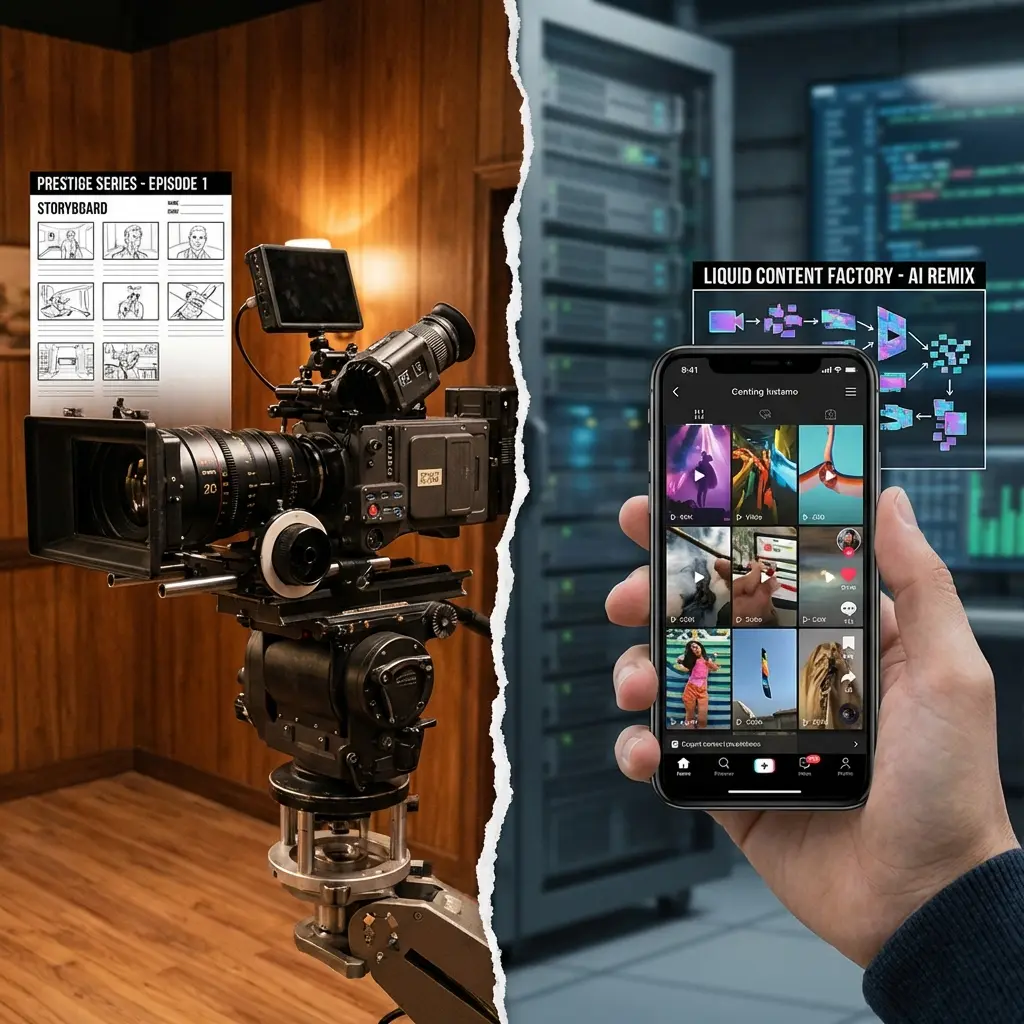
Veo 3: The Liquid Content Factory
To keep the Shorts feed infinite, YouTube needs massive volume. Recently, the platform unveiled Google's Veo 3 AI integration for Shorts, featuring text-to-video generation, AI-powered remixing, and automated editing.
These aren't just tools to empower creativity—they are solving a liquidity problem. YouTube wants content that can be endlessly reformatted. They are building infrastructure to turn creators into content factories, prioritizing platform stickiness over narrative depth.
The 3-Step Plan for YouTube Success in 2026
If you design your content strategy based on Mohan’s vision of prestige series, you are building on shifting sand. To capture attention and drive sales today, you must design for liquid content. Here is how:
1) Design for Modular Production, Not Prestige Series
Stop shooting single, linear videos. Instead, design modular productions. Shoot in a way that allows you to cleanly extract Shorts, generate auto-dubs for global markets, and dynamically swap out segments using AI tools. You aren't just producing a video; you are producing a rich data set of visual assets that can be sliced into a hundred different pieces. Think asset library, not finished product.
2) Build for the Swappable Slot Economy
A major shift in 2026 is dynamic ad-slot insertion. Stop thinking about brand integrations as permanent stamps on a single video. Design for recurring revenue models. Your production workflow should include clean, interchangeable segments so a successful video from this year can be refreshed with a new hook or offer two years from now without ever requiring a reshoot.
3) Start with the Short, Not the Series
Co-production in 2026 must start with the Short. If a concept doesn't have 60-second viral or remix potential, investing in a long-form version is a high-risk gamble. Design your visual hooks for the short-form feed first, using them as the primary discovery engine to grab attention.
Don't Let the Algorithm Hold Your Brand Hostage
Pretending the platform supports prestige co-productions when the system is optimized for liquid content factories will leave you frustrated and underfunded.
You can still create incredibly valuable content on YouTube, but you have to build for what the platform actually is.
Stop feeding an algorithm that ignores your best work.
Let’s talk about building a modular, future-proof video library that commands attention, dominates the feed, and actually grows your business.
DesignRush animation studio reference
https://www.designrush.com/agency/video-production/animation
About the author: